
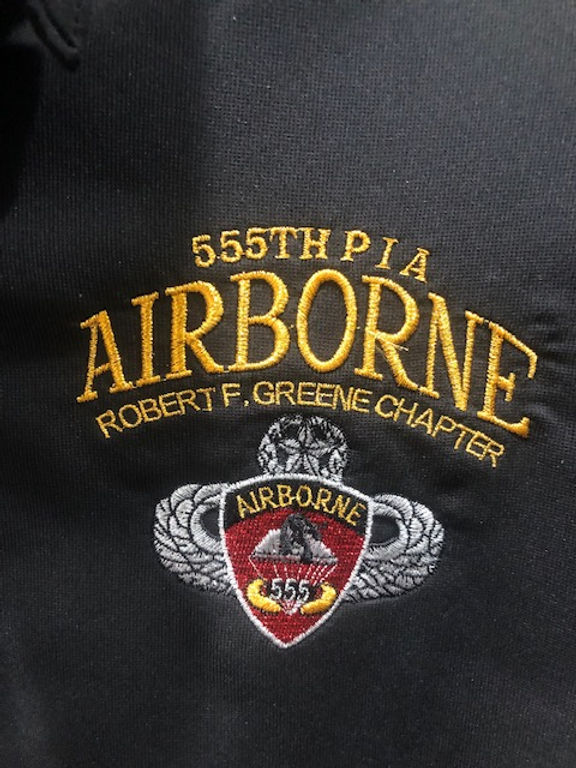


Contact Info
3645 Marketplace Blvd.
Suite 130-771
East Point, GA 30344-5747
(678) 592-5262
President
(404) 201-5949
Vice President
Meetings every 1st Saturday at 10 am
VFW Post 6449
6000 Rivertown Road
Fairburn, GA 30213

Webmaster: robertfgreene555@gmail.com
- Mission -
To create awareness and educate the public about the history of America’s first Black Paratroopers, the 555th Parachute Infantry Battalion, while providing comprehensive support services that address food insecurity, homelessness, housing instability, and economic empowerment for families.
You do not need to have any military affiliation in order to be a member.
"The Triple Nickles"
The 555th Parachute Infantry Battalion
1944 - 1947
In the frosty Georgia winter of 1943–44, soldiers traveling to and from Fort Benning often saw the sky filled with white parachutes. Most assumed the faces beneath them were also white. At that time, the Black soldiers they knew drove trucks, waited on mess hall tables, or hauled ammunition. They rode in the back of the bus to and from Columbus and gathered at separate, segregated clubs on post. Some of the faces beneath those chutes, however, were Black. As the first Black paratroopers in U.S. history, these men were pioneers, blazing trails for countless soldiers to follow.
Blazing Trails Under Jim Crow
It wasn't easy. A proud Black lieutenant, sergeant, or private—with polished boots and paratrooper wings—still had to use the "colored" toilets and drinking fountains in railroad stations, sit in segregated sections of theaters, and go out of his way to avoid confrontations with racist police. Black officers routinely found post officers' clubs closed to them.
But they endured, and they proved themselves as airborne troopers. In the words of the notoriously fussy General Ben Lear, they were: "As fine a group of soldiers as I have ever seen."
These pioneers were exceptional men, specially selected for the task. They were former university students, professional athletes, and top-notch veteran non-commissioned officers (noncoms). A major element in their success was their leadership structure. Unlike other Black infantry units of the era that were officered by whites, the 555th was entirely Black, from the commanding officer down to the newest private.
Growth and the Call for Replacements
Through December 1944 and January 1945, the Triple Nickles continued to jump, maneuver, and grow to a strength of over 400 battle-ready officers and men. During that same period, a far more deadly action was taking place on the battlefields of Belgium: The Battle of the Bulge. This massive German counterattack in the Ardennes resulted in some 77,000 American casualties. Many were paratroopers from the 82nd and 101st Airborne Divisions who had made the heroic stand at Bastogne. The cry was out for combat replacements across Europe. "At last we thought we were going to tangle with Hitler, whose embarrassment at the 1936 Olympics by a Black American named Jesse Owens was fresh in our minds. We eagerly anticipated pitting the Nazis against another group of Black champions—men like Walter Morris, 'Tiger Ted' Lowry, Jabo Allen, Edwin Wills, Jim Bridges, and Roger Walden." — From "The Triple Nickles" by Bradley Biggs
However, the military determined the 555th would not deploy overseas as a full battalion because they had not yet done large-scale battalion maneuvers. Original orders stated battalion training couldn't begin until they reached 29 officers and 600 enlisted men—a metric that could have been achieved much faster if army-wide commanders had approved and released the scores of Black volunteers requesting parachute duty.
Turning Restrictions into Strength
The smaller headcount did have advantages. It allowed the unit to concentrate on intensive individual and small-unit training:
-
Marksmanship: Riflemen, machine gunners, and mortar men sharpened their aim to perfection.
-
Hand-to-Hand Tactics: Training in judo and close combat was intensified. No "goof-offs" were allowed.
-
Specialized Schools: Men were sent to specialized schools to become expert riggers, jumpmasters, pathfinders, demolition experts, and communications specialists.
Eventually, the Triple Nickles would grow to more than 1,300 men for duty, with 600 in jump training at Fort Benning and 1,900 on the morning report rosters.
Operation Firefly & The Smokejumpers
Though combat-ready and alerted for European duty in late 1944, the changing tides of the war resulted in a completely different, highly classified assignment: Jumping over the blazing forests of the American Northwest to fight Japanese balloon bombs.
In the closing months of the war, Japan launched thousands of hydrogen balloons carrying incendiary devices into the jet stream, aiming to ignite catastrophic forest fires across the Pacific Northwest. This assignment required exact skills, immense physical stamina, and a special kind of courage. In this role, the 555th also confronted a terrifying new dimension of warfare: the potential use of biological agents designed to destroy woodlands and crops.
A Mission of Absolute Secrecy
The population of the West Coast would have been seriously alarmed to learn that these weapons were successfully landing on American shores. Consequently, the 555th approached Operation Firefly committed to absolute secrecy. We realized that any slip on our part, or any breach of security, could bring panic to the West Coast and damage the nation's morale. We were also acutely aware of the domestic stakes; only recently, fear and prejudice had been vented on Japanese-American citizens, stripping them of their rights and placing them in intercontinental camps. That Americans of German and Italian descent were spared this treatment did not escape our attention.
The Gear of a Smokejumper
During inspections, these Army paratroopers stood at ease outfitted for the wilderness. The men were issued standard "let-down" ropes (to rappel out of the old-growth trees if they got caught in the canopy) and football helmets with wire face masks to protect against branches. For insulation against the brutal conditions, they often wore heavy sheepskin outer garments rather than standard canvas smokejumper suits.
Brothers in Arms, Bound by Purpose
Inthis mission, and in many others, the 555th was highly successful. We became a superb organization because of our unwavering belief in ourselves and each other.
We worked together. We were not greedy for promotion or publicity, nor did we engage in the army's political games. Our game was soldiering. It took a total effort and a collective frame of mind that recognized that everything we did was for a special purpose. As Black men in competition with whites, we knew that if we failed, it might be a very long time before Black soldiers were given another chance.
The Legacy of the "Triple Nicklers"
For us, integration meant survival and advancement in what was then a white man's army. But the foundations we laid changed that army forever.
By breaking barriers, the Triple Nickles paved the way for future generations. Our veterans went on to father and serve in more airborne units, in peace and war, than almost any other parachute group in military history, including the:
-
82nd, 101st, 11th, and 13th Airborne Divisions
-
3rd Battalion, 505th Airborne Infantry Regiment
-
80th Airborne Anti-Aircraft Battalion
-
503rd Airborne Artillery Battalion
-
2nd Airborne Ranger Company
-
187th Airborne Regimental Combat Team
-
188th and 511th Airborne Infantry Regiments
-
The Airborne Center and Special Forces
"I wish that it were possible to name and write about every trooper who has ever enjoyed the prestige and spirit of being a Triple Nickler. But that cannot be done here. I hope that those who are unnamed in the pages that follow will recognize that in the history of each of us lies at least some of the history of all of us." — 1st Sgt. Walter Morris